 All Kinds Of Analytical Instruments, Electronics Meter & Environmental Equipment's Importer & Supplier.
 Hotline: +8801602 028999, Sales: +8801602 028992
 astoninstruments@gmail.com
 9.30AM - 7.00PM (Saturday ~ Thursday) |
 House: 205, Shop No: 03, Wirless Railgate, Boro Moghbazar, Dhaka-1217.


 Light Box & Accessories
 Verivide Light Box


 Weight Scale & Balance

 Machine & Spares


 Gsm Cutter & Spares


 Testing Meter & Tester


 Pantone Color Guide


 Lab Consumables


 Glassware & Plasticware

 Chemical & Reagent

 Laboratory Detergent


 Lamp & Elec. Ballast

 Others



Moisture Analyzer: Complete Guide to Working Principle, Types, Uses, Accuracy & Selection

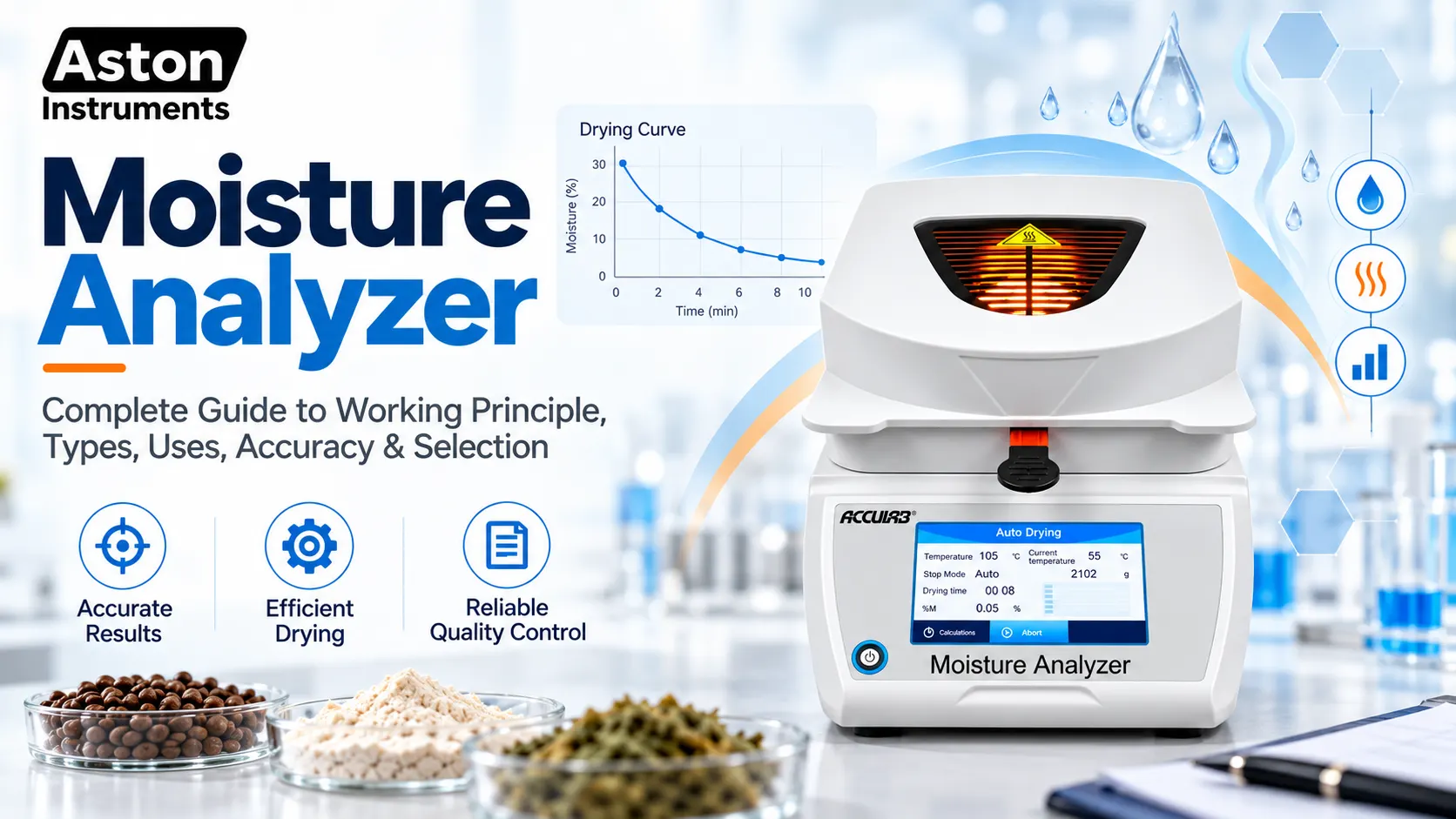
A moisture analyzer is a laboratory instrument used to determine the moisture content of a sample by measuring how its mass changes during controlled drying. Most laboratory moisture analyzers combine a precision weighing system, a heating unit and software that continuously calculates the change in sample mass as drying progresses.
Moisture analyzers are also commonly called moisture balances, particularly when the instrument combines weighing and drying in a single unit.
They are widely used in laboratory testing, quality control, production monitoring, product development and incoming-material inspection across industries including food, pharmaceuticals, textiles, agriculture, chemicals and plastics.
preparation, drying temperature, drying program and switch-off criterion as key parameters when developing a reliable Loss on Drying method.
This Aston Instruments guide explains the complete moisture-analysis process from the fundamental working principle through method development, accuracy, calibration, industrial applications and moisture-analyzer selection.
What Is a Moisture Analyzer?
A moisture analyzer is an instrument that determines the amount of moisture in a material by weighing a sample before and during controlled heating. As moisture and other volatile components leave the sample, its mass decreases. The analyzer monitors this change and calculates a moisture result according to the selected method.
A typical laboratory moisture analyzer contains three core systems:
- a precision balance for measuring sample mass;
- a controlled heating system for drying the sample;
- software for monitoring mass loss and calculating the final result.
This integrated design eliminates many of the separate weighing, drying, cooling and calculation steps required by conventional oven-based Loss on Drying procedures.
Moisture analyzers are therefore particularly useful where laboratories or production teams need relatively fast results for routine quality-control decisions.
The terms moisture analyzer and moisture balance are often used for the same type of laboratory instrument. Adam Equipment, for example, also describes moisture analyzers as moisture balances and explains their operation through the Loss on Drying principle.
What Is Moisture Content?
Moisture content describes the quantity of moisture present in a material.
Depending on the industry and test method, it may be reported as:
- a percentage of the original sample mass;
- a percentage relative to dry solids;
- a mass ratio;
- or another method-specific unit.
Moisture content can influence the physical, chemical and processing characteristics of materials. In commercial and laboratory environments, controlling moisture can affect product consistency, storage behavior, processing efficiency and final-product quality.
A moisture-content result should therefore always be interpreted together with the measurement method used to obtain it. Two different analytical methods do not necessarily measure exactly the same property.
Why Is Moisture Analysis Important?
Moisture is an important quality parameter because changes in moisture level can alter how a material behaves during manufacturing, storage and use.
Depending on the material, moisture can influence:
| Area | Potential influence of moisture |
| Raw materials | Acceptance, handling and consistency |
| Manufacturing | Processing behavior and production stability |
| Finished products | Weight, texture, physical properties and consistency |
| Storage | Caking, degradation or other changes |
| Quality control | Batch-to-batch comparability |
| Research | Formulation and process-development decisions |
The relevant moisture specification will depend on the material, industry, product and quality system.
For this reason, professional moisture analysis should be treated as a defined analytical method, rather than simply as an instrument reading.
How Does a Moisture Analyzer Work?
A moisture analyzer generally works according to a thermogravimetric principle: the instrument applies heat while continuously monitoring changes in sample mass.
The basic process is:
Prepare sample → measure initial mass → heat sample → monitor mass loss → reach endpoint → calculate result
Although the principle appears straightforward, each step can affect measurement quality.
1. Measuring the Initial Sample Weight
The prepared sample is placed on a clean sample pan.
The analyzer’s weighing system records the initial sample mass before or at the beginning of the drying process.
Reliable results start with consistent sample handling. If replicate samples differ significantly in mass, composition or distribution across the pan, repeatability can suffer.
2. Heating the Sample
After weighing, the heating system raises the sample to the selected drying temperature.
Modern laboratory moisture analyzers commonly use halogen or infrared heating.
Unlike a conventional drying oven, where samples are primarily heated by convection, a moisture analyzer typically uses infrared radiation from its heating element to transfer energy to the sample. Sample characteristics affect how that energy is absorbed and therefore how quickly the material dries.
3. Moisture and Volatile Components Leave the Sample
As the sample is heated, moisture begins to evaporate.
The balance continuously monitors the falling sample mass.
The initial stages of drying may be relatively fast when easily removable surface moisture is present. Drying usually slows as the remaining moisture becomes progressively more difficult to remove.
4. The Analyzer Detects the Drying Endpoint
A moisture test cannot continue indefinitely.
The analyzer therefore requires a defined rule for determining when the test is complete.
This rule is commonly called the switch-off criterion, endpoint criterion or stop criterion.
Some methods stop after a defined time. Others automatically stop when sample mass changes by less than a defined amount during a specified period.
5. Moisture Content Is Calculated
A common wet-basis calculation is:
Moisture (%) = [(Initial Mass − Final Dry Mass) ÷ Initial Mass] × 100
For example:
Initial sample mass = 10.00 g
Final mass = 8.00 g
Mass lost = 2.00 g
Moisture result on a wet basis:
(2 ÷ 10) × 100 = 20%
The instrument performs this calculation automatically according to its selected result mode.
Loss on Drying (LOD) Explained
Loss on Drying, commonly abbreviated LOD, is a thermogravimetric technique that determines the amount of mass a material loses under specified drying conditions.
The general process is:
Wet sample weight → drying → final weight → mass difference
LOD can be performed using a conventional drying oven and balance or through an integrated moisture analyzer.
A major advantage of the moisture analyzer is that weighing, heating and result calculation take place in one instrument.
However, an important scientific distinction is often overlooked:
Loss on Drying does not necessarily measure only water.
It measures the total mass lost from the sample under the defined test conditions. Depending on the material, this may include water as well as solvents, oils, fragrances or other volatile components. METTLER TOLEDO explicitly defines LOD in terms of total mass loss during drying, including potentially multiple volatile substances.
This distinction matters when developing or validating a moisture method.
What Is Thermogravimetric Moisture Analysis?
The word thermogravimetric can be understood as:
Thermo = heat
Gravimetric = mass or weight measurement
A thermogravimetric moisture method therefore determines a result by observing how sample mass changes when heat is applied.
Both conventional drying-oven LOD and many laboratory moisture analyzers use this basic concept.
The key difference is workflow.
With a conventional oven method, the operator may need to:
weigh the sample, place it in the oven, dry it, cool it under appropriate conditions, reweigh it and calculate the result.
A moisture analyzer integrates much of this process into one instrument and continuously monitors mass during drying.
Does a Moisture Analyzer Measure Only Water?
Not necessarily.
This is one of the most important concepts to understand when interpreting moisture-analyzer results.
A heating-based moisture analyzer measures mass lost under the selected drying conditions. If the sample contains volatile compounds in addition to water, those compounds may also leave the material and contribute to the measured mass loss.
Likewise, excessive heating can potentially trigger thermal decomposition in some materials.
Main Components of a Moisture Analyzer
Understanding the main parts of the instrument makes it easier to evaluate specifications and troubleshoot results.
Precision Weighing System
The balance measures the initial sample mass and tracks small mass changes throughout drying.
One important specification is readability, which describes the smallest mass increment displayed by the instrument.
Readability should not be confused with overall measurement accuracy.
Heating Unit
The heating system provides controlled thermal energy to remove moisture from the sample.
Its design affects:
- heating speed;
- temperature control;
- sample response;
- available drying programs.
Halogen Lamp
Many modern moisture analyzers use halogen heating because halogen elements respond quickly and allow controlled infrared heating.
The goal is not simply to make the sample as hot as possible. The purpose is to dry it under conditions appropriate to the material and analytical method.
Temperature Sensor
A temperature-control system helps the analyzer regulate the selected heating conditions.
Temperature performance is especially important because excessive or insufficient heating can distort results.
Sample Pan
The sample pan holds the test material.
Pan dimensions and sample distribution influence heat transfer. A thin, even sample layer generally promotes more uniform drying than a thick pile concentrated in one area.
Controller and Display
The interface allows users to set parameters such as:
- temperature;
- drying program;
- time;
- endpoint criterion;
- result mode.
More advanced analyzers may also store methods and previous results.
Data Connectivity
Depending on the model, moisture analyzers may include interfaces such as RS232, USB, Ethernet or printer connections for documentation and data transfer.
Types of Moisture Analyzers
Moisture analyzers can be classified according to the technology used to dry or analyze the sample.
Halogen Moisture Analyzer
A halogen moisture analyzer combines a precision balance with a halogen heating element.
The lamp rapidly provides controllable infrared energy while the balance monitors sample mass.
Halogen analyzers are widely used for routine laboratory and QC applications because they combine weighing, drying and calculation in one instrument.
Infrared Moisture Analyzer
Infrared moisture analyzers use infrared radiation to heat the sample while monitoring mass loss.
Halogen heating itself is a form of infrared heating, so terminology can overlap between manufacturers.
The more meaningful comparison is often the design and performance of the specific heating system rather than the marketing term alone.
Microwave Moisture Analysis
Microwave-based systems use electromagnetic energy to heat water-containing materials.
They can be useful for particular applications but differ significantly in design and analytical approach from a typical laboratory halogen moisture balance.
Other Moisture Measurement Technologies
Not every instrument used to determine moisture operates by Loss on Drying.
Other techniques include:
- Karl Fischer titration;
- near-infrared spectroscopy;
- electrical resistance or capacitance moisture meters;
- specialized microwave or sensor-based methods.
The best technique depends on the sample, required specificity, expected moisture level and quality-control objective.
What Is a Halogen Moisture Analyzer?
A halogen moisture analyzer is a thermogravimetric moisture-measurement instrument that combines a precision weighing system with a halogen heating source.
The sample is weighed, exposed to controlled heating and monitored as its mass decreases.
Halogen heating is popular because the heating element responds quickly and can be controlled over a defined temperature range.
A typical workflow is:
Weigh → heat → monitor mass loss → detect endpoint → calculate moisture result
Halogen analyzers can be especially useful for routine QC where users need results more quickly than a traditional oven workflow can provide.
For laboratories evaluating this technology in Bangladesh, Aston Instruments supplies the Acculab MA120-3H halogen moisture analyzer, which combines laboratory weighing with programmable controlled heating for moisture-content testing.
Free Moisture, Bound Moisture and Chemically Bound Moisture
Not all water within a material behaves in exactly the same way.
Understanding this helps explain why two materials with similar total moisture levels may dry differently.
Free Moisture
Free or relatively available moisture is generally easier to remove during drying.
It may exist on surfaces, within pores or in regions where it is not strongly associated with the material structure.
This portion of moisture often leaves first during heating.
Bound Moisture
Bound water interacts more strongly with components of the material.
Sugars, salts, proteins, fibers and other substances can influence how water is held within a product.
As a result, bound moisture may require more energy or time to remove.
Chemically Bound Water
Some materials contain water that is incorporated more strongly into their chemical or crystal structure.
Removing this water may require substantially different conditions and, in some cases, may involve structural or chemical change.
These differences are one reason why a universal moisture-analyzer temperature cannot be recommended for every sample.
Wet-Basis vs Dry-Basis Moisture Content
Moisture results can be expressed on different calculation bases.
Failure to identify the basis can cause confusion when comparing results.
Wet-Basis Moisture Content
Wet-basis moisture expresses the mass of moisture relative to the original total sample mass.
Wet-basis moisture (%) = [(Initial Mass − Dry Mass) ÷ Initial Mass] × 100
Suppose:
Initial mass = 10 g
Dry mass = 8 g
Moisture lost = 2 g
Wet-basis result:
2 ÷ 10 × 100 = 20%
Dry-Basis Moisture Content
Dry-basis moisture expresses the moisture mass relative to the dry-solid mass.
Dry-basis moisture (%) = [(Initial Mass − Dry Mass) ÷ Dry Mass] × 100
Using the same example:
2 ÷ 8 × 100 = 25%
Why the Calculation Basis Matters
A sample can therefore be reported as:
20% moisture wet basis
and
25% moisture dry basis
without either figure being mathematically incorrect.
Always verify which reporting basis is required before comparing results between laboratories, instruments or specifications.
How to Use a Moisture Analyzer
Operating procedures vary by manufacturer and model, but a typical laboratory workflow follows the same general principles.
1. Prepare the instrument.
Place the analyzer on a stable surface away from excessive vibration and drafts. Confirm that the pan and surrounding area are clean.
2. Prepare a representative sample.
Homogenize, grind, cut or otherwise prepare the material when appropriate.
3. Select the analytical method.
Choose the required temperature, drying program and endpoint criterion.
4. Place the sample on the pan.
Distribute the sample in a thin and reasonably even layer.
5. Start the measurement.
The analyzer records initial mass and begins heating.
6. Allow drying to continue to the defined endpoint.
Avoid opening or disturbing the unit unnecessarily.
7. Review the result.
Check the final moisture value and any available drying information.
8. Document the result.
Record or transfer the data according to the laboratory’s quality procedure.
9. Clean the instrument after testing.
Remove sample residue before the next measurement.
Always follow the operating and safety instructions for the specific analyzer and material being tested. Some samples can burn, release hazardous vapors or react dangerously when heated.
Sample Preparation for Accurate Moisture Analysis
Good sample preparation is often as important as instrument specification.
Use a Representative Sample
The sample placed on the pan should represent the larger batch being evaluated.
Testing an unrepresentative portion can produce an instrumentally precise result that does not reflect the actual material.
Control Sample Size
Using excessively large samples can increase drying time and may create temperature or moisture gradients.
Samples that are too small may be more sensitive to handling or weighing variation.
The optimal mass should be established during method development.
Spread the Sample Evenly
A thin and even layer supports more uniform heat transfer.
Consider Particle Size
Large pieces may dry unevenly because surface moisture leaves before moisture inside the material can migrate outward.
Grinding or reducing particle size can improve uniformity where appropriate, but sample preparation itself must not cause unwanted moisture gain or loss.
Handle Hygroscopic Materials Quickly
Hygroscopic samples can absorb moisture from surrounding air.
Long delays between sample collection, preparation and testing can therefore change the material before the analysis begins.
Watch for Skin Formation
Some liquids, pastes or other materials can form a dry surface layer during heating.
This skin can slow moisture release from the interior.
Method adjustments or the use of appropriate sample aids may help.
Prevent Sample Scorching
If a sample darkens, burns or decomposes during the test, the temperature may be too high or the heating program unsuitable.
Changing the drying profile may provide a more reliable result.
Glass-Fiber Filters
Certain liquid or difficult samples may benefit from suitable glass-fiber pads or filters that increase surface area and improve distribution.
Their suitability should be validated for the application.
Drying Temperature, Programs and Endpoint Criteria
A moisture analyzer is only as reliable as the analytical method used with it.
Three particularly important variables are:
drying temperature + drying program + endpoint criterion
Selecting the Drying Temperature
If the temperature is too low, drying may take too long or fail to remove the target moisture adequately.
If the temperature is too high, the sample may:
- scorch;
- decompose;
- lose additional volatile materials;
- form a surface skin.
The correct temperature should therefore be determined experimentally and, where necessary, validated against a suitable reference method.
Standard Drying
Standard drying maintains a defined drying condition and is appropriate for many stable sample types.
Rapid Drying
Some instruments use a more aggressive initial heating phase to shorten analysis time.
This can be useful for appropriate samples but may not suit heat-sensitive materials.
Gentle or Ramp Drying
Ramp or gentle programs increase temperature progressively rather than applying the final temperature immediately.
This approach can help with samples that are vulnerable to scorching, splattering or skin formation.
Step Drying
Step programs use multiple temperature stages.
They can be useful for materials containing components that behave differently at different temperatures.
Not every moisture analyzer supports every drying program. The available method options depend on the specific instrument.
What Is the Switch-Off Criterion in a Moisture Analyzer?
The switch-off criterion defines when the moisture analyzer should consider the drying process complete.
A commonly used automatic approach evaluates the rate of mass loss.
For example, if the sample is losing less than a predefined amount of mass over a specified period, the instrument can interpret the result as stable and stop the test.
The criterion matters because:
Stopping too early can leave the sample incompletely dried.
Stopping unnecessarily late can increase analysis time and potentially expose the sample to unwanted thermal effects.
For reliable QC, the same validated switch-off criterion should be consistently applied to equivalent samples.
What Is a Drying Curve?
A drying curve shows how sample mass or moisture result changes as drying progresses.
Conceptually:
Vertical axis: sample mass or moisture
Horizontal axis: drying time
A typical curve may show:
- an initial period where heating begins;
- rapid loss of easily removed moisture;
- slower drying as remaining moisture becomes harder to remove;
- a final region where mass change becomes very small.
The curve can provide useful clues about method behavior.
For example:
- continued rapid weight loss near the endpoint may indicate premature stopping;
- an unusually long plateau may indicate an inefficient method;
- sudden behavior changes can suggest sample reactions or method problems.
Some modern analyzers display real-time drying curves to support method development and result review.
What Affects Moisture Analyzer Accuracy?
Reliable moisture measurement depends on more than balance readability.
Important factors include:
| Factor | Why it matters |
| Sample representativeness | Poor sampling can invalidate the result |
| Sample mass | Influences drying behavior and weighing response |
| Sample thickness | Thick samples may dry unevenly |
| Particle size | Large particles can retain internal moisture |
| Drying temperature | Too high or low can distort results |
| Heating program | Changes the thermal exposure of the sample |
| Endpoint criterion | Determines when measurement stops |
| Other volatiles | May contribute to LOD mass loss |
| Weight calibration | Influences mass measurement |
| Temperature performance | Influences drying conditions |
| Environment | Drafts, vibration and temperature changes may affect weighing |
| Operator technique | Inconsistent preparation reduces repeatability |
Readability Is Not the Same as Accuracy
This distinction is important when comparing moisture analyzers.
Readability is the smallest mass increment the instrument displays.
Accuracy describes how closely a measurement agrees with an appropriate reference or accepted value under defined conditions.
An instrument with high readability can still produce a poor analytical result if the sample is badly prepared or the drying method is unsuitable.
Common Moisture Analysis Errors and How to Avoid Them
| Problem | Possible cause | Practical response |
| Sample burns or darkens | Drying temperature too high | Reduce temperature or use gentler heating |
| Results vary significantly | Sample inconsistency | Improve homogenization and preparation |
| Drying takes too long | Thick sample layer or low temperature | Adjust sample amount/distribution and method |
| Test stops too quickly | Endpoint criterion unsuitable | Review switch-off setting |
| Result is unexpectedly high | Other volatile materials are evaporating | Compare against an appropriate reference method |
| Surface dries but interior remains wet | Skin formation | Modify preparation or drying program |
| Replicates differ | Sample mass/distribution varies | Standardize preparation |
| Results drift over time | Instrument performance or environment | Verify weight/temperature performance and conditions |
Troubleshooting should focus on the entire measurement process, not only the instrument.
Moisture Analyzer Calibration and Routine Testing
A moisture analyzer combines at least two critical functions:
weighing and heating.
Both influence the final result.
Weight Calibration or Adjustment
The weighing system can be checked using appropriate reference weights according to the manufacturer’s procedure.
Temperature Verification
The heating system may require verification using a suitable temperature-calibration accessory or procedure.
How Often Should a Moisture Analyzer Be Calibrated?
There is no universal interval suitable for every laboratory.
Frequency should be determined according to factors such as:
- instrument use;
- laboratory quality requirements;
- environmental conditions;
- risk associated with incorrect results;
- manufacturer recommendations;
- internal SOPs.
Regular routine checks can help identify changes before they affect important production or QC decisions.
Moisture Method Development
There is rarely one universal setting that works equally well for every sample.
A robust moisture method typically defines:
- sample preparation;
- sample quantity;
- drying temperature;
- drying program;
- endpoint criterion;
- result calculation basis.
Method Validation
Method validation helps demonstrate that the selected analyzer method is suitable for its intended purpose.
One common approach is to compare moisture-analyzer results with an established reference procedure.
For example, a laboratory moving from a validated drying-oven method to a halogen analyzer may test multiple representative samples using both procedures and evaluate agreement and repeatability.
Reference-Method Correlation
A fast moisture analyzer should not automatically be assumed to produce the same result as a drying oven merely because both are based on mass loss.
Heating behavior differs between the technologies.
The objective is therefore to develop analyzer conditions that produce results appropriately correlated with the relevant reference method.
Measurement Uncertainty
Every analytical measurement has uncertainty.
Potential contributors in moisture analysis include:
sample variation, balance performance, heating behavior, repeatability, environmental conditions and operator technique.
For high-value or regulated applications, laboratories should evaluate uncertainty according to their applicable quality procedures rather than relying only on the resolution displayed on the screen.
What Is a Moisture Analyzer Used For?
Moisture analyzers are used wherever moisture content is an important laboratory, manufacturing or quality-control parameter.
Typical purposes include:
- incoming raw-material inspection;
- production monitoring;
- process optimization;
- formulation development;
- batch-to-batch comparison;
- finished-product QC;
- research and development.
The exact method should always be matched to the material being tested.
Moisture Analyzer Applications by Industry
Food and Beverage
Moisture content can influence texture, processing behavior, ingredient consistency, weight and storage characteristics.
Potential applications include testing:
- flour;
- grains;
- spices;
- powders;
- processed food ingredients;
- agricultural raw materials.
Food laboratories should also understand that moisture content and water activity are different measurements, which is discussed later in this guide.
Pharmaceutical Laboratories
Moisture testing may be used during:
- incoming-material analysis;
- powder and granule evaluation;
- formulation development;
- process monitoring;
- laboratory QC.
The appropriate method depends on the material and applicable quality requirements.
Textile Industry
Moisture can influence the mass, handling and processing behavior of textile materials.
Moisture-analysis applications may include:
- fibers;
- yarn;
- fabrics;
- textile raw materials;
- process and quality-control samples.
For textile laboratories, repeatable sample conditioning and preparation are particularly important because many fibers can exchange moisture with the surrounding atmosphere.
Aston Instruments works within the laboratory and textile-testing equipment sector in Bangladesh, making moisture analysis particularly relevant for textile manufacturers and QC facilities that require consistent laboratory measurement.
Agriculture
Moisture analysis can support evaluation of:
- grains;
- seeds;
- feed materials;
- agricultural ingredients;
- some fertilizer and raw-material applications.
The most suitable method depends on the sample and required testing standard.
Plastics and Polymers
Excess moisture in some polymers and resins can affect processing and finished-product quality.
Where an LOD method is suitable, moisture analyzers can provide relatively fast QC results.
Very low moisture applications may require specialized methods or method validation.
Chemical and Industrial Materials
Powders, chemicals, minerals and other industrial materials are commonly evaluated for moisture or LOD as part of manufacturing and laboratory QC.
Where the sample contains solvents or other volatile substances, results should be interpreted carefully because thermogravimetric methods may measure more than water alone.
Research and Quality-Control Laboratories
Moisture analyzers are particularly useful for laboratories testing many routine samples where rapid feedback supports production or formulation decisions.
Moisture Analyzer vs Moisture Meter
The terms are sometimes used loosely, but a laboratory moisture analyzer and a handheld moisture meter often operate very differently.
| Feature | Laboratory Moisture Analyzer | Typical Handheld Moisture Meter |
| Principle | Heating + mass loss | Often electrical resistance, capacitance or another indirect method |
| Sample handling | Usually requires a sample on a pan | Often measures directly on/in material |
| Typical environment | Laboratory or QC area | Field, production floor, construction, storage |
| Measurement | Thermogravimetric LOD | Often indirect moisture estimate |
| Test effect | Usually destructive | Often non-destructive or minimally destructive |
| Typical materials | Powders, ingredients, granules, pastes and solids | Wood, grain, building materials and other application-specific materials |
The correct instrument depends on whether the user needs laboratory LOD analysis or rapid application-specific field measurement.
Moisture Analyzer vs Drying Oven
Both moisture analyzers and drying ovens can be used for Loss on Drying, but their workflows differ significantly.
| Factor | Moisture Analyzer | Drying Oven |
| Weighing | Integrated | Usually performed separately |
| Heating | Infrared/halogen depending on analyzer | Primarily convection |
| Monitoring | Continuous mass monitoring | Typically initial and final weighing |
| Analysis time | Often relatively fast | Commonly longer |
| Handling | Fewer separate steps | More manual steps |
| Samples per run | Commonly one per analyzer | Multiple samples may be processed together |
| QC suitability | Strong for rapid routine decisions | Common reference approach |
| Method correlation | Should be validated where replacing reference method | Often forms the established reference procedure |
The right question is therefore not:
“Which instrument is always more accurate?”
It is:
“Which validated method best meets the analytical and operational requirements of this application?”
Moisture Analyzer vs Karl Fischer Titration
A moisture analyzer and Karl Fischer titration answer related but different analytical questions.
| Moisture Analyzer | Karl Fischer |
| Measures mass lost during heating | Chemically determines water |
| Other volatile materials may affect result | More specific to water |
| Uses heating + weighing | Uses chemical reaction |
| Useful for rapid LOD/QC applications | Valuable when water specificity is required |
| Method depends strongly on drying behavior | Method depends on chemistry and sample compatibility |
Lab Manager summarizes the distinction clearly: halogen analyzers and ovens determine weight lost during heating, whereas Karl Fischer titration is designed to measure water specifically.
The choice therefore depends on the meaning of the required specification.
Moisture Analyzer vs NIR Moisture Measurement
Near-infrared spectroscopy, or NIR, is another approach to rapid moisture analysis.
Unlike an LOD moisture analyzer, NIR generally does not dry the sample and measure lost mass.
Instead, it uses spectral information and a calibration model to predict moisture.
This can make NIR extremely fast for suitable high-throughput applications, but model quality and calibration are critical.
An LOD analyzer, by comparison, directly observes the mass change produced by the defined drying process.
Moisture Content vs Water Activity
Moisture content and water activity are related, but they are not the same parameter.
Moisture content describes how much moisture or water is present in the material.
Water activity describes the energy state or availability of that water and can provide information about its ability to participate in microbial, physical or chemical processes.
AQUALAB explains that two products can contain similar amounts of water but behave differently because that water may be held differently within the product.
A moisture analyzer used for Loss on Drying therefore should not be described as a water-activity meter.
For products where shelf-life or microbial stability is a key concern, moisture content and water activity may provide complementary information.
How to Choose a Moisture Analyzer
The best moisture analyzer is not simply the model with the highest capacity or smallest displayed increment.
The instrument should match the sample, method and operational requirement.
1. Capacity
Consider the maximum amount of sample you may need to weigh.
More capacity can provide flexibility, but it does not automatically improve moisture-analysis quality.
2. Weight Readability
Readability indicates the smallest mass increment displayed by the balance.
Applications involving small samples or subtle mass changes may require finer readability.
3. Moisture Result Resolution
Check how finely moisture results are displayed.
Again, displayed resolution should not be confused with analytical accuracy.
4. Temperature Range
Make sure the available drying-temperature range supports the materials and methods you intend to use.
5. Heating Technology
Halogen heating is widely used for laboratory moisture analysis because it offers responsive controlled heating.
Other technologies may be preferable for specialized applications.
6. Drying Programs
Where samples vary significantly, options such as standard, rapid, ramp or step drying may provide useful flexibility.
7. Endpoint Controls
Automatic, timed or programmable stop criteria can affect both repeatability and analysis time.
8. Sample Pan Size
A suitable pan makes it easier to distribute samples evenly.
9. Calibration and Verification
Consider how the weighing and temperature systems can be checked or adjusted.
10. Method Storage
If the laboratory tests several routine products, stored methods can reduce setup variation between operators.
11. Connectivity
RS232, USB, printer or network functionality may be valuable where results need to be documented or transferred.
12. Technical Support
Instrument selection should include more than specifications.
Application guidance, installation support, training, spare parts and service availability can all affect long-term usability.
Important Moisture Analyzer Specifications Explained
| Specification | What it means | Why it matters |
| Maximum capacity | Highest permitted sample/load mass | Determines weighing flexibility |
| Weight readability | Smallest displayed weight increment | Influences resolution of mass measurement |
| Moisture resolution | Smallest displayed moisture increment | Determines displayed result detail |
| Drying temperature range | Available heating range | Determines method flexibility |
| Temperature increment | Smallest selectable temperature step | Supports method control |
| Heating source | Halogen, infrared or another technology | Influences drying behavior |
| Sample pan size | Available sample area | Influences distribution |
| Drying programs | Available heating profiles | Helps accommodate different samples |
| Endpoint settings | Criteria used to finish measurement | Influences test time and repeatability |
| Calibration | Available weight/temperature checks | Supports confidence in instrument performance |
| Data interface | RS232, USB, Ethernet, etc. | Supports documentation and transfer |
Specifications should always be evaluated together with the intended sample and analytical method.
Moisture Analyzers for Laboratory Testing in Bangladesh
Organizations selecting a moisture analyzer in Bangladesh should consider more than the initial purchase price.
A suitable procurement decision should evaluate:
application compatibility, technical specifications, calibration options, operator requirements, after-sales support and availability of technical guidance.
Different industries may also have very different requirements.
A textile QC laboratory, for example, may prioritize repeatable material conditioning and routine batch testing, while a food laboratory may need methods optimized for powders, ingredients or processed samples.
Working with a laboratory-equipment supplier that understands both the instrument and the intended application can help reduce the risk of purchasing equipment based on specifications alone.
Acculab MA120-3H Halogen Moisture Analyzer
For laboratories and quality-control facilities evaluating a professional halogen moisture analyzer in Bangladesh, Aston Instruments supplies the Acculab MA120-3H.
According to Aston Instruments’ current product specification, the MA120-3H offers a weighing range up to 120 g, halogen heating, a 90 mm pan, PT-100 temperature sensing, external calibration and programmable temperature settings from 40°C to 199°C in 1°C steps. The current product listing specifies a moisture measurement range of 0.001%–100%.
The instrument can support moisture-analysis applications in laboratory, food, pharmaceutical, textile, agricultural, chemical and industrial QC environments where an appropriate Loss on Drying method has been established.
Explore the Acculab MA120-3H Moisture Analyzer from Aston Instruments for complete specifications, availability and purchasing information.
Frequently Asked Questions About Moisture Analyzers
What is a moisture analyzer?
A moisture analyzer is a laboratory instrument that determines moisture content by measuring changes in sample mass during controlled heating. It combines a precision weighing system, heating unit and calculation software in one instrument.
How does a moisture analyzer work?
The instrument first weighs the sample, then heats it while continuously monitoring mass. As moisture and other volatile components leave the sample, its weight decreases. When the selected endpoint is reached, the analyzer calculates the result from the mass change.
What is the working principle of a moisture analyzer?
Most laboratory halogen moisture analyzers operate according to the thermogravimetric Loss on Drying principle. This means moisture is evaluated by measuring the sample’s change in mass while it is heated under defined conditions.
What is Loss on Drying?
Loss on Drying is a method in which a sample is weighed before and after drying. The reduction in mass is reported according to the selected calculation method. The loss can include water and other volatile substances.
What is a halogen moisture analyzer?
A halogen moisture analyzer combines a precision balance with a halogen heating element. It continuously weighs the sample during heating and calculates moisture or Loss on Drying based on the resulting mass change.
What is a moisture analyzer used for?
Moisture analyzers are commonly used for raw-material inspection, laboratory QC, process monitoring, product development and finished-product testing across food, pharmaceutical, textile, chemical, agricultural, plastics and other industries.
Does a moisture analyzer measure only water?
No. A Loss on Drying moisture analyzer measures mass lost during heating. Depending on the material, this can include water plus other volatile substances. Karl Fischer titration is a different technique designed specifically to determine water.
How much sample should be used in a moisture analyzer?
There is no universal sample mass for every material. The appropriate quantity depends on sample characteristics, instrument capability and the validated method. Consistent sample mass and distribution generally improve repeatability.
What temperature should be used for moisture analysis?
The correct drying temperature depends on the sample. Temperatures that are too low can result in slow or incomplete drying, while excessive temperature may cause scorching, decomposition or loss of additional volatile compounds.
How accurate is a moisture analyzer?
Accuracy depends on the instrument, sample, preparation technique and drying method. Balance readability alone does not determine accuracy. A suitable method, calibration, consistent preparation and reference-method validation are important where high confidence is required.
What is a switch-off criterion?
A switch-off criterion is the rule the moisture analyzer uses to determine when drying is complete. Automatic criteria commonly monitor the rate of mass loss and stop the test when weight change becomes sufficiently small over a defined period.
What is the difference between wet-basis and dry-basis moisture?
Wet-basis moisture expresses moisture relative to the original sample mass. Dry-basis moisture expresses moisture relative to the final dry-solid mass. Because the denominator differs, the percentages can also differ for the same sample.
How often should a moisture analyzer be calibrated?
Calibration or verification frequency should be based on usage, risk, laboratory quality procedures, environmental conditions and manufacturer recommendations. Both weighing and temperature performance may need to be checked.
Is a moisture analyzer better than oven drying?
Not universally. A moisture analyzer usually provides faster, more integrated testing, while drying ovens remain established reference methods for many applications. If a moisture analyzer replaces an existing oven method, results should be appropriately correlated or validated.
What is the difference between a moisture analyzer and a moisture meter?
A laboratory moisture analyzer typically determines moisture through controlled heating and mass loss. Many handheld moisture meters instead use electrical resistance, capacitance or other indirect principles for rapid field measurements.
How do I choose a moisture analyzer?
Choose based on your sample type, required capacity, readability, drying-temperature range, heating technology, method flexibility, calibration options, endpoint controls, data requirements and available technical support not on a single specification alone.
Conclusion
A moisture analyzer is much more than a balance with a heater.
Reliable moisture analysis depends on understanding the relationship between sample preparation, weighing, heating, drying behavior, endpoint selection and result calculation.
For routine laboratory and quality-control applications, modern halogen moisture analyzers can provide fast and repeatable Loss on Drying measurements while reducing many of the separate steps associated with conventional oven testing.
By treating moisture determination as a complete analytical process rather than simply an instrument reading, laboratories can achieve more meaningful and defensible results.
For organizations looking for a laboratory moisture analyzer in Bangladesh, Aston Instruments provides Machine & Spares equipment, Moisture Meter and technical product information for laboratory, textile, industrial and quality-control applications.
The Acculab MA120-3H Halogen Moisture Analyzer is one option for laboratories requiring controlled halogen drying combined with precision weighing for routine moisture-content analysis.


